

Global Packaging Waste Recycling Market Set for Structural Shift, Reaching Nearly USD 50 Billion by 2036 | FMI Reports
Packaging Waste Recycling Market
UK packaging waste recycling market to grow at 5.2% CAGR (2026–2036), driven by cost-led regulation, EPR fees, eco-modulation, and rapid material redesign.
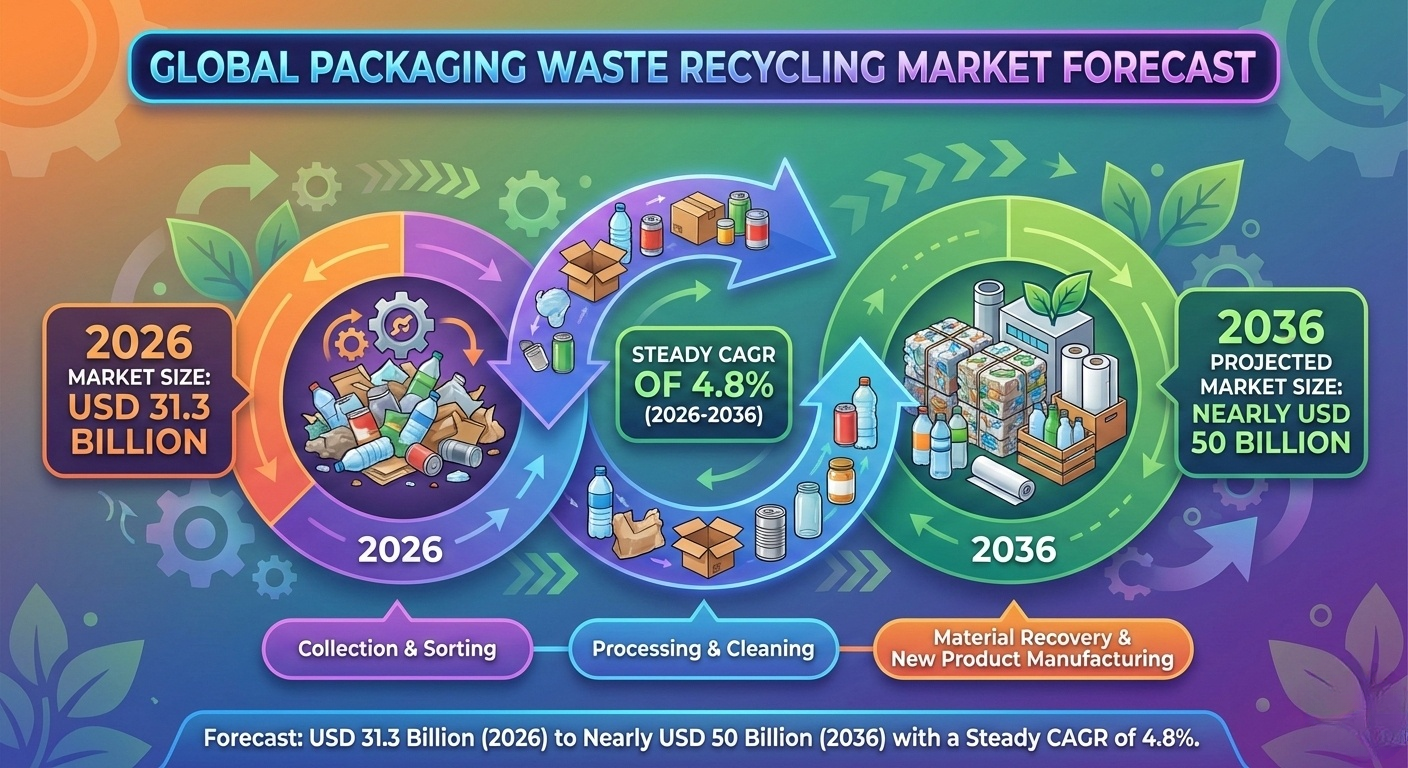
NEWARK, DE, UNITED STATES, February 9, 2026 /EINPresswire.com/ -- The global packaging waste recycling market is undergoing a structural transformation from fragmented waste handling into a regulated, compliance-led industrial system, according to a new outlook by Future Market Insights (FMI). The market is valued at USD 31.3 billion in 2026 and is projected to reach nearly USD 50 billion by 2036, expanding at a compound annual growth rate (CAGR) of 4.8% over the forecast period.
FMI’s analysis finds that growth is no longer driven by packaging consumption volumes or voluntary sustainability pledges. Instead, it is anchored in mandatory recycling regulations, extended producer responsibility (EPR) enforcement, recycled content mandates, and traceability requirements, which are reshaping capital allocation and competitive positioning across global packaging and materials supply chains.
Uncover the Massive Potential of the Market – Get Our Sample Report Now
https://www.futuremarketinsights.com/reports/sample/rep-gb-6948
Market Overview: Who, What, Why, and How
• Who: Regulated recyclers, waste management companies, chemical recycling operators, packaging manufacturers, and brand owners operating under enforceable recycling and recycled content mandates.
• What: Organized collection, sorting, mechanical and chemical recycling, and reprocessing of post-consumer and post-industrial packaging waste into secondary raw materials and certified feedstocks.
• When: From 2026 through 2036, with 2026 identified as a regulatory inflection point.
• Where: Global, with Europe leading by value, followed by North America, and accelerated growth in East Asia, South Asia, and selected OECD markets.
• Why: Governments are converting recycling from a voluntary initiative into a mandatory industrial activity, backed by penalties, material bans, and recycled content thresholds.
• How: Through accelerated investment in automated sorting, mixed waste recovery, chemical recycling, mono-material redesign, and closed-loop systems.
FMI concludes that the market has crossed into a phase where compliant infrastructure not scale alone determines long-term value creation.
Key Market Metrics (2026–2036)
• Market Size (2026): USD 31.3 billion
• Projected Market Size (2036): Nearly USD 50.0 billion
• CAGR (2026–2036): 4.8%
• Growth Character: Compliance-led rather than consumption-driven
Regulatory Enforcement Reshapes Regional Dynamics
• European Union: Enforcement of the Packaging and Packaging Waste Regulation (PPWR) and the August 2026 PFAS ban is triggering portfolio resets, accelerating shifts toward mono-material designs and fiber-based packaging, and driving capital into regulated recycling infrastructure.
• India: Mandatory recycled content norms have validated industrial-scale recovery of flexible plastics, converting previously unrecoverable waste into required feedstock.
• China: Relocation of green polymer and methanol-based assets is creating a structural feedstock advantage, positioning the country as an exporter of high-purity recycled resins.
• United States: Fragmented EPR exposure is prompting divestment from flexible multilayer formats, while large-scale chemical recycling and mass balance accounting are enabling recycled polymers to function as industrial feedstocks.
• Saudi Arabia: Vision 2030 mandates are translating into automated sorting and waste-to-fuel hubs, reinforcing industrial recovery capacity.
Industry leaders echo this shift. PepsiCo’s Chief Sustainability Officer Jim Andrew noted that scaling recycled plastics requires “collection, processing, and enabling policy.” L’Oréal CEO Nicolas Hieronimus emphasized aligning economic performance with environmental accountability.
Structural Shifts Defining Market Evolution
FMI analysts identify several globally unique trends shaping the market:
• Conversion of recycling into a mandatory industrial activity
• Rapid deployment of AI-enabled and automated sorting
• Industrial-scale chemical recycling for food-grade polymers
• Portfolio exits from EPR-exposed flexible plastics
• Repositioning of recycled polymers as export-grade feedstocks
The market is evolving into a regulated feedstock manufacturing system, where control over food-grade post-consumer recycled (PCR) materials and mass balance–certified supply chains defines competitiveness.
Segment Highlights: Where Demand Is Concentrated
By Material
• Paper and paperboard dominate with a 44.9% share in 2026, supported by mature closed-loop systems, high collection efficiency, and regulatory clarity.
• Plastics remain exposed to volatility despite chemical recycling scale-up, while metals, glass, and wood-based materials play secondary roles.
By Form
• Primary packaging accounts for approximately 62% of recycled volumes, reflecting regulatory focus on direct food and product contact materials.
By Packaging Format
• Rigid packaging leads with a 58% market share, benefiting from established mechanical recycling systems and food-grade reuse pathways.
• Flexible packaging remains structurally challenged due to contamination risk and recovery losses.
By Recycling Process
• Mechanical recycling represents about 85% of installed capacity in 2026.
• Chemical recycling, while expanding rapidly, remains a capacity unlock mechanism rather than a volume leader.
By End Use
• Food and beverages drive demand with a 46% share, reflecting high compliance exposure and sustained competition for food-grade PCR.
Country-Level Growth Outlook
Countries projected to grow above the global average CAGR of 4.8% include:
• United States: 5.6%
• South Korea: 5.4%
• United Kingdom: 5.2%
• Japan: 4.9%
FMI attributes higher growth rates to policy enforcement intensity, faster infrastructure rollout, and procurement pressure for compliant recycled feedstock.
Competitive Landscape: Infrastructure and Technology Take Priority
The competitive environment is increasingly defined by regulatory positioning, feedstock control, and proprietary processing technologies:
• Infrastructure leaders such as Veolia and Republic Services are strengthening upstream feedstock access through acquisitions and advanced sorting hubs.
• Technology leaders Eastman and ExxonMobil are shaping the chemical recycling tier with billion-pound-scale depolymerization assets.
• In Asia, companies including Avro India Ltd and PolyCycl are emerging as cost disruptors aligned with EPR mandates.
Outlook Through 2036
Future Market Insights concludes that packaging waste recycling is no longer a discretionary sustainability activity. It is becoming a regulated industrial backbone of global packaging supply chains, where compliance, infrastructure readiness, and feedstock security determine growth, resilience, and long-term value creation through 2036.
Why FMI: https://www.futuremarketinsights.com/why-fmi
Have a Look at Related Research Reports on the Packaging Domain:
Event-Based Stationery Packaging Market https://www.futuremarketinsights.com/reports/event-based-stationery-packaging-market
Cable Retention Packaging Market https://www.futuremarketinsights.com/reports/cable-retention-packaging-market
Poly Peel Sheets Market https://www.futuremarketinsights.com/reports/poly-peel-sheets-market
Wearable Device Packaging Market https://www.futuremarketinsights.com/reports/wearable-device-packaging-market
About Future Market Insights (FMI)
Future Market Insights, Inc. (FMI) is an ESOMAR-certified, ISO 9001:2015 market research and consulting organization, trusted by Fortune 500 clients and global enterprises. With operations in the U.S., UK, India, and Dubai, FMI provides data-backed insights and strategic intelligence across 30+ industries and 1200 markets worldwide.
Sudip Saha
Future Market Insights Inc.
+1 347-918-3531
email us here
Legal Disclaimer:
EIN Presswire provides this news content "as is" without warranty of any kind. We do not accept any responsibility or liability for the accuracy, content, images, videos, licenses, completeness, legality, or reliability of the information contained in this article. If you have any complaints or copyright issues related to this article, kindly contact the author above.
